
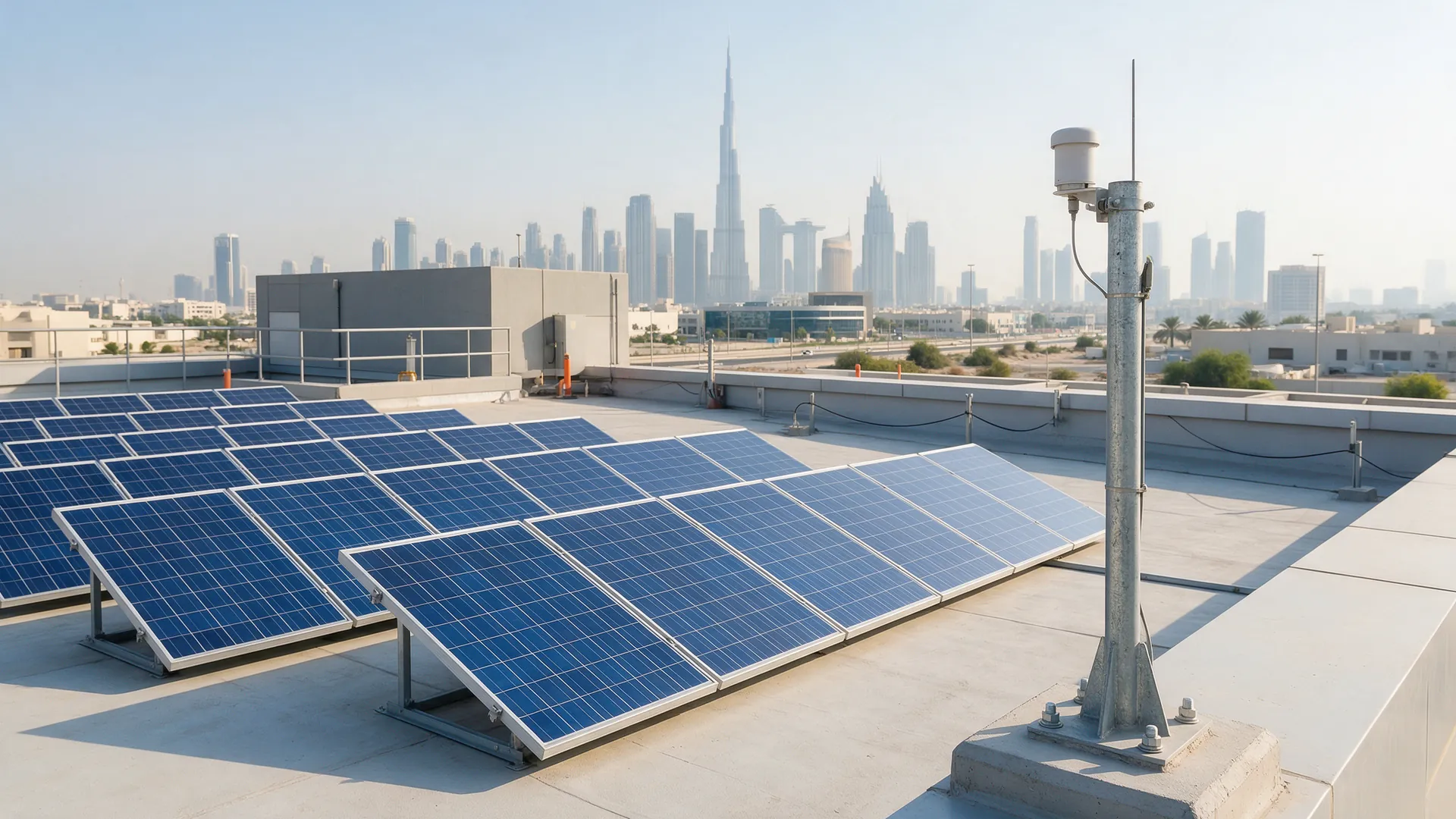
- Federal Decree-Law No. 11 of 2024 has been in force since 30 May 2025 and sets up a national measurement, reporting and verification (MRV) system for greenhouse gas emissions.
- Advisers disagree on reach: some say every emitter is covered with no size threshold, while Meysan reads reporting duties as arising once an entity is designated as a source.
- Reported administrative fines run from AED 50,000 to AED 2,000,000, higher for repeat breaches; we saw no published enforcement cases.
- A simple Scope 1 and 2 inventory and at least five years of supporting records is a proportionate step while scope questions remain open.
Federal Decree-Law No. 11 of 2024 on reducing the effects of climate change has been in force since 30 May 2025 and sets up a national system for measuring, reporting and verifying greenhouse gas emissions.
Whether a small UAE business must report today depends on whether it has been designated as an emissions source, and sources disagree on how far the duty reaches, so the safe step is to find out where you stand rather than assume you are outside it.
Advisers often describe the law as applying to every business with no size threshold, while other summaries say the obligations bite once the climate ministry or a local authority designates an entity as a source. This guide sets out what is confirmed, what is contested and what a small company can sensibly do now without overbuilding a sustainability programme.
| Detail | What applies |
|---|---|
| Law | Federal Decree-Law No. 11 of 2024 on the Reduction of Climate Change Effects |
| In force | 30 May 2025, with a one-year adjustment period reported to end 30 May 2026 |
| Reporting platform | National MRV system, launched 15 October 2025 per Meysan; the mrv.ae portal is cited by advisers |
| Emissions in scope | Scope 1 (direct) and Scope 2 (purchased energy) greenhouse gas emissions |
| Penalties | Administrative fines of AED 50,000 to AED 2,000,000, higher for repeat breaches |
| Record keeping | At least five years, per Hadef & Partners |
“The law reaches businesses that release greenhouse gases, but the practical duty to report may arrive through designation. Waiting to be told is a gamble when the fines start at AED 50,000.”
What the law does
The decree-law moved climate reporting in the UAE from voluntary disclosure to a legal framework. It was issued in August 2024, came into force on 30 May 2025, and covers public and private entities in the country, including free zones, whose operations release greenhouse gases. It anchors a national measurement, reporting and verification system run by the Ministry of Climate Change and Environment, known as MOCCAE.
It sits beside an earlier instrument, Cabinet Resolution No. 67 of 2024, which created the National Register of Carbon Credits and took effect on 28 December 2024. That resolution defines a class of Huge Carbon Emission Entities as those emitting 0.5 million tonnes of carbon dioxide equivalent or more a year across Scopes 1 and 2, and sets registration and monitoring duties for them. A small business is nowhere near that line, but the two instruments are often blurred together.
See our guide on the checklist of compliance items every UAE business carries to see where an environmental item sits next to licence, tax and employment duties.
Who is actually covered
Here the sources diverge, and it is worth being plain about it. Several adviser articles say the law applies to every entity that emits greenhouse gases, with no minimum size, revenue or sector threshold. That reading comes from the definition of a source, which covers legal persons and individual enterprises whose activities release gases into the atmosphere.
Meysan, a law firm, reads the framework more narrowly in practice: reporting obligations apply once MOCCAE or the competent emirate or free zone authority designates the entity as a source. Under that reading, a company that has not been designated has no live duty to report, even though it is within the law’s reach in principle. Meysan also reports that entities below the 0.5 million tonne line may opt in voluntarily.
We could not open the decree-law text on the official legislation portal to settle the point, so we cannot say which reading will prevail. What can be said with confidence is that a large industrial emitter should assume it is in scope, and a small office-based business should find out whether it has been or will be designated rather than assuming it is exempt.
Consider a hypothetical 25-person logistics firm with two leased warehouses, a fleet of eight vans and a Dubai office. Its direct emissions come from diesel and petrol, and its indirect emissions come from the electricity it buys.
Even if nobody has designated it as a source, an annual figure for fuel litres and kilowatt-hours would let it answer a request from MOCCAE, a free zone authority or a corporate customer within days. The firm and its numbers are invented for illustration.
See our guide on cost, CRN and requirements for a UAE logistics licence if your business runs vehicles or depots, since transport fuel is a typical Scope 1 source.
What reporting involves
Covered entities are expected to measure Scope 1 and Scope 2 emissions using recognised methods, usually the Greenhouse Gas Protocol, and report through the national system. Scope 1 means emissions from sources you own or control, such as fuel burned in vehicles, generators and boilers. Scope 2 means emissions from purchased electricity, heat or cooling. Advisers cite the Integrated Emissions Quantification Tool on the mrv.ae platform as the calculation and submission route.
Commentary says Scope 3, the value chain emissions, is expected to follow later, with some advisers pointing to 2027. We found no primary source for that date, so treat it as speculation. Meysan adds that independent assurance from a MOCCAE-approved verifier is expected, and that implementing regulations had not been published when it wrote. Both points can change how much work a report takes.
See our guide on the UAE mainland industrial licence and facility requirements if you operate a plant, as manufacturers are among the sectors most likely to be asked for emissions data first.
Penalties as published
The figure most often quoted is an administrative fine of AED 50,000 to AED 2,000,000, with higher penalties for repeat violations. Hadef & Partners states the range, and Meysan adds that the amount doubles for a repeat offence within two years. Meysan also lists separate tiers under the carbon register resolution, at AED 500,000, AED 1,000,000 and AED 2,000,000 for first, second and third offences, which we have not independently verified.
Two cautions apply. A headline of “up to AED 2 million” can make a small firm assume that it will be fined at that level; the range suggests the penalty is meant to scale with the breach. And we have not seen published enforcement cases or a schedule linking particular breaches to particular amounts, so there is no basis for predicting the likely fine for a minor reporting lapse.
See our guide on who actually falls within scope of the operational risk management regulation for another example of a rule where reading the scope clause carefully matters more than the headline.
Record keeping and evidence
Whatever the scope answer, the evidence trail is the same, and it is cheap to start. Keep monthly or quarterly utility bills for every site, fuel card statements or fuel purchase records, generator logs, refrigerant top-up records for air conditioning, and a list of company vehicles with fuel type. These are the raw inputs to a Scope 1 and 2 calculation.
The record retention period reported by Hadef & Partners is at least five years, which matches the rhythm of other UAE compliance files. Store the data with the methodology note explaining the emission factors you used and the date you used them, because an assurance provider or regulator will ask for both. A spreadsheet is enough for a small firm; the discipline matters more than the tooling.
See our guide on the free zone warehouse and industrial licence if your operation is in a zone, as the zone authority is one of the bodies that can designate sources.

What a small business should check
First, ask your licensing authority or free zone whether it has issued any notice on source designation or MRV registration, and note the answer in writing. Second, check whether you are a tenant in a building or park that reports on behalf of occupants, because some landlords may collect utility data from tenants. Third, review contracts with large customers or lenders for ESG data clauses; those may ask for emissions figures long before the regulator does.
Fourth, size the problem. A desk-based consultancy with a rented office has a modest Scope 2 footprint and almost no Scope 1. A cloud kitchen, workshop or transport operator has more. Proportionate effort means a simple annual inventory, not a consultant-led programme. Finally, watch for MOCCAE guidance, because the implementing rules may change who must register and how verification works.
See our guide on the UAE Blue Visa route for climate and marine conservation work for a different side of the UAE’s climate policy, in which environmental activity carries residency benefits instead of reporting duties.
Building a simple emissions inventory
A first inventory for a small business can be done in a week. Define the boundary: which legal entities, premises and vehicles are in it. Choose a reporting year, normally the calendar year. List each fuel and energy source and gather twelve months of data in the units on the bill, such as litres of diesel or kilowatt-hours of electricity.
Then apply emission factors. The Greenhouse Gas Protocol approach multiplies activity data by a factor for each fuel or grid, and the result is expressed in tonnes of carbon dioxide equivalent. The national tool is the official route for submission, but a business can prepare its numbers in a spreadsheet first and then enter them, which also gives it something to compare against the tool’s output.
Document every assumption. If a landlord does not give you a separate meter reading, note how you estimated your share, for example by floor area. If a refrigerant top-up was undertaken by a contractor, keep the service report, because refrigerant leaks count as Scope 1 emissions.
A realistic expectation is useful here. For an office-based business the whole exercise may show that electricity is almost the entire footprint, and that the most useful action is simply to keep the bills and the method on file. For a workshop or fleet operator, fuel dominates, and the inventory may also point to savings that justify the effort on cost grounds alone.
Finally, assign ownership. Someone in finance or operations should be named as responsible for collecting the data each quarter, because emissions numbers assembled in a rush at year-end are usually the ones that later fail a review. A short annual note to management, giving the total, the main sources and the change from the prior year, is enough to show the business is paying attention.
Common mistakes when approaching climate law reporting
- Treating the claim of “no threshold” as proof that a duty to file already exists, or as proof that nothing applies.
- Confusing the 0.5 million tonne Huge Carbon Emission Entity line with the wider law, and concluding the whole framework is irrelevant to a small firm.
- Waiting for a designation notice before collecting any data, then having no records when a request arrives.
- Relying on a generic online carbon calculator and an undated emission factor without recording the method.
When professional help is worth it
Outside help is worth it where you run industrial processes, a large fleet or multiple sites, where a customer or lender has asked for verified figures, or where you are unsure whether a designation notice has arrived. An environmental consultant can build the inventory, and a legal adviser can interpret the scope question and track the executive regulations.
An e.zone consultant who handles licensing and regulatory compliance can help confirm which authority supervises your licence and what it expects. See e.zone’s guide on legal compliance for SMEs in the Middle East for the wider compliance picture.
This is general information and not legal advice. The scope and implementing rules were still being clarified when we checked, so confirm your position with MOCCAE or your licensing authority.
Frequently asked questions
Do small UAE businesses have to report greenhouse gas emissions?
It depends on how the law is read. Some advisers say it applies to every emitter with no size threshold, while Meysan says reporting duties apply once the ministry or a local authority designates the entity as a source. We could not open the decree-law text to settle the point, so find out whether you have been or will be designated.
What emissions are covered?
Scope 1 (direct emissions, such as fuel burned in vehicles and generators) and Scope 2 (purchased electricity, heat or cooling). Scope 3 is expected by some advisers to follow later, but we found no primary source for a date.
What are the penalties?
Hadef & Partners states administrative fines of AED 50,000 to AED 2,000,000, with higher penalties for repeat violations. We have not seen enforcement cases or a schedule linking breaches to amounts.
How long should emissions records be kept?
Hadef & Partners reports at least five years.
Talk to a setup advisor
Free 20-minute call to confirm the right structure for your business.
Related Reading
 Legal & Compliance
 UAE Power of Attorney and Document Attestation for Company Setup
 Legal & Compliance
 UAE Competition Law Executive Regulations 2026: Notification Thresholds and Merger Control
 Legal & Compliance
 UAE Non-Profit Company Law 2026: How Federal Decree-Law No. 20 Creates a New Entity Category
 Legal & Compliance