
- A mainland industrial licence requires both DET trade licence approval and separate federal MoIAT registration.
- MoIAT requires a minimum AED 250,000 facility capital and at least 10 employees for an Industrial Production Certificate.
- Dubai Industrial City offers purpose-built SME manufacturing packages starting from AED 28,000.
- Realistic first-year total for genuine manufacturing runs AED 250,000-600,000.
- Export-focused manufacturers often find a free zone structure more duty-efficient than mainland.
- MoIAT periodically reviews whether a manufacturer still meets its capital and headcount conditions at renewal.
A UAE mainland industrial licence starts at AED 15,000 to 25,000 for the trade licence itself, but the Ministry of Industry and Advanced Technology adds its own federal requirements on top: a minimum manufacturing facility capital of AED 250,000 and at least 10 employees before a business can hold an Industrial Production Certificate. Dubai Industrial City offers purpose-built SME manufacturing packages starting from AED 28,000, but the realistic first-year total for a genuine manufacturing operation, once warehouse or factory space and MOIAT compliance are included, runs AED 250,000 to 600,000 depending on scale.
This guide covers what actually separates a mainland industrial licence from a standard trade licence, the MOIAT registration most founders discover only after applying for their DET licence, and Dubai Industrial City as the purpose-built alternative to a standalone mainland factory setup.
Why an industrial licence means two separate government approvals, not one
A mainland industrial licence is not simply a trade licence with a different activity code; it requires both the standard Department of Economy and Tourism trade licence approval and a separate federal registration with the Ministry of Industry and Advanced Technology, which oversees industrial licensing nationally rather than at the emirate level. A founder who secures DET approval for a manufacturing activity but has not separately registered with MoIAT does not hold a complete industrial licence, even though the DET-issued document may look identical to any other trade licence on its face.
This two-layer structure exists because manufacturing activities carry federal-level economic policy considerations, around industrial capacity, local sourcing, and strategic sector development, that a purely emirate-level trade licence approval does not capture. Understanding that MoIAT registration is a distinct, additional step, not a formality bundled automatically into DET approval, is the first thing any founder planning a genuine manufacturing operation needs to internalize before budgeting a timeline.
| Requirement | Detail |
|---|---|
| DET mainland trade licence, government fees | AED 12,000 – 25,000 |
| Full mainland industrial licence range | AED 15,000 – 25,000+, scaling with activity |
| MoIAT minimum manufacturing facility capital | AED 250,000 |
| MoIAT minimum employee count | 10 employees |
| Dubai Industrial City SME package, starting from | AED 28,000 |
| Typical realistic first-year total (genuine manufacturing) | AED 250,000 – 600,000 |
“A DET trade licence tells the emirate you’re allowed to operate. MoIAT registration tells the federal government you’re actually manufacturing something. A business that only has the first one isn’t legally holding an industrial licence, whatever the paperwork looks like on the surface.”
Why MoIAT’s capital and headcount minimums exist, and who they actually screen out
The AED 250,000 minimum manufacturing facility capital and the 10-employee minimum headcount requirement together function as a substance test, designed to distinguish genuine manufacturing operations from businesses that want the branding or trade benefits of an industrial licence without the underlying production capacity to match. A founder planning a very small-scale production operation, such as a workshop-style business producing modest volumes with a handful of staff, may find these thresholds genuinely block the mainland industrial licensing route entirely, since MoIAT does not offer a scaled-down version of these requirements for smaller operations.
For businesses that cannot realistically meet the capital and headcount thresholds, the practical alternative is often to structure the business under a different activity classification that better matches its actual scale, such as a workshop or light assembly activity that falls outside MoIAT’s industrial production certificate requirements, rather than forcing a small operation into an industrial licensing framework built around genuine manufacturing scale.
Consider a founder planning a small furniture assembly workshop with an initial team of four staff and a modest facility investment well under AED 250,000, who applied for a mainland industrial licence assuming that any manufacturing-adjacent activity qualified. The DET trade licence itself was approved without issue, but the subsequent MoIAT registration for the Industrial Production Certificate was declined, since the operation fell well short of both the minimum facility capital and the 10-employee threshold. The founder ultimately restructured under a lighter workshop and assembly activity classification that did not require the Industrial Production Certificate, avoiding the MoIAT thresholds entirely while still legally operating the intended business.
Why Dubai Industrial City exists as the purpose-built alternative
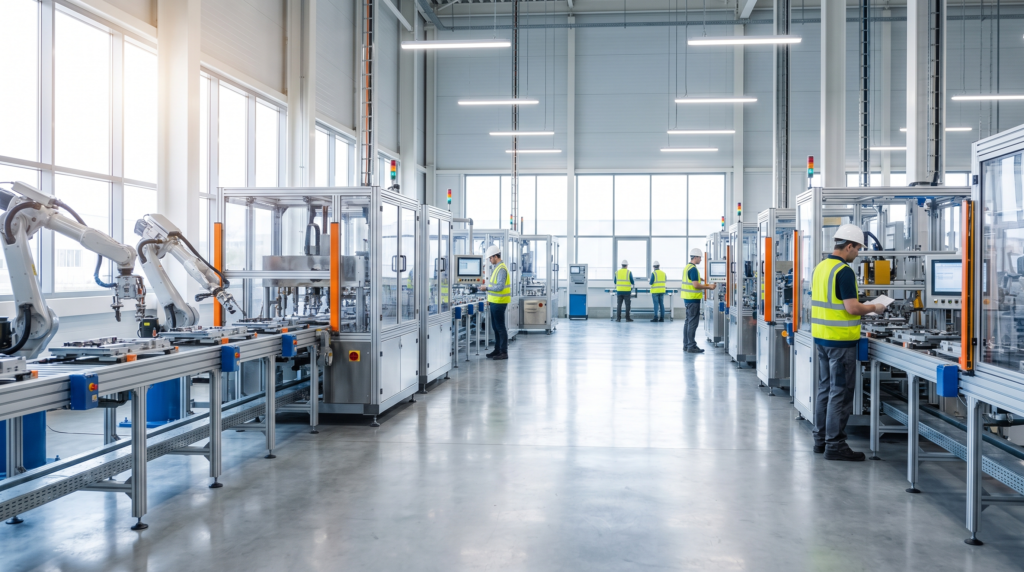
Dubai Industrial City offers SME-focused manufacturing packages starting from AED 28,000, built specifically around light to medium manufacturing activities with purpose-built warehouses, factory units, and worker accommodation already in place, removing much of the site search and facility build-out burden a standalone mainland manufacturing setup would otherwise carry. For a founder who has already confirmed their operation meets MoIAT’s capital and headcount thresholds, Dubai Industrial City often represents a faster path to an operational facility than sourcing and fitting out an independent mainland industrial plot.
The tradeoff is that Dubai Industrial City, like other purpose-built industrial zones, comes with its own zoning and activity restrictions tailored to the manufacturing sectors it is designed around, meaning a highly specialized or unusual manufacturing activity should confirm zone compatibility before committing, rather than assuming any manufacturing business fits the standard package structure.
Other emirates offer comparable purpose-built industrial zones worth comparing before defaulting to Dubai specifically, including options in Abu Dhabi and Sharjah that sometimes offer lower base costs or sector-specific incentives for manufacturers in food production, packaging, or light engineering. A founder should treat the emirate choice itself as a genuine variable in the setup decision, not an afterthought decided purely by where the founder happens to already live or operate other businesses.

What the physical facility actually needs to include
Beyond the general capital and headcount thresholds, MoIAT registration requires the facility itself to be appropriately zoned and equipped for the specific manufacturing activity being registered, meaning a generic warehouse lease does not automatically satisfy the requirement if the space lacks the power capacity, ventilation, or safety infrastructure a given production process actually needs. Founders should confirm facility specifications against their specific manufacturing process before signing a lease, since a mismatch discovered after the lease is signed and MoIAT registration is submitted is considerably more expensive to correct than confirming compatibility upfront.
Civil Defence approval, covering fire safety and emergency systems appropriate to industrial activity, runs alongside the MoIAT registration process and can become the pacing item in a facility timeline if the space’s safety systems are not already built to industrial standard before the inspection is scheduled.
Mainland or free zone for a manufacturing business?
A mainland industrial licence suits a manufacturer intending to sell directly into the UAE domestic market without restriction, since mainland registration removes the limitations free zone companies face when serving mainland customers directly. A manufacturer focused primarily on export, however, may find a free zone industrial setup more efficient, since many free zones offer duty exemptions on imported raw materials and re-exported finished goods that a mainland operation does not automatically receive in the same way. See our guide on how JAFZA and DAFZA compare on warehouse and industrial licensing cost for how the leading free zone alternatives compare on cost and export-oriented advantages.
The manufacturing activity itself, specifically whether it qualifies as a Qualifying Activity under the UAE’s free zone corporate tax rules, can also weigh into this decision, since manufacturing is explicitly included on the Ministry of Finance’s qualifying activities list for free zone companies, potentially making a free zone structure more tax-efficient for an export-oriented manufacturer than the equivalent mainland setup.
Why raw material sourcing shapes the licensing decision more than founders expect
A manufacturing business’s raw material sourcing pattern, whether inputs are imported, sourced domestically, or a mix of both, has a direct bearing on which jurisdiction and licensing structure actually minimizes total landed cost. An operation importing the bulk of its raw materials can find meaningful duty advantages in a free zone structure with bonded warehousing, while one sourcing primarily from UAE-based suppliers may find those free zone import advantages largely irrelevant to its actual cost structure, making mainland registration the simpler and equally cost-effective choice. Mapping the actual supply chain before choosing a jurisdiction, rather than defaulting to whichever structure seems more prestigious, tends to produce a meaningfully different and more accurate cost comparison.
How Emiratisation requirements interact with industrial licensing
Manufacturing businesses meeting certain headcount thresholds fall within the scope of the UAE’s Emiratisation quota requirements, which mandate a minimum percentage of UAE national employees across qualifying mainland companies. Given that MoIAT’s own 10-employee minimum already places most industrial licence holders within range of these thresholds, founders planning a manufacturing operation should factor Emiratisation compliance into their staffing plan from the outset rather than treating it as a separate, later consideration. See our guide on UAE Emiratisation quota expansion and what changed for mainland SMEs in 2026 for the current thresholds and compliance requirements this headcount level triggers.
What ongoing compliance actually looks like after the licence is issued
An industrial licence does not simply renew alongside the trade licence on autopilot; MoIAT periodically reviews whether a registered manufacturer continues to meet the capital and headcount conditions that justified its original Industrial Production Certificate, and a business that has scaled down its facility or workforce since initial approval can face questions at renewal that a standard trade licence renewal would never raise. Founders should treat the capital and headcount thresholds as an ongoing operating condition, not a one-time approval hurdle cleared at setup and then forgotten.
Environmental and safety compliance also tends to intensify over a manufacturing business’s lifecycle rather than staying static. Civil Defence and municipality inspections at renewal time often check whether safety systems have kept pace with any changes in production volume or process since the facility was first approved, meaning a business that has scaled up output without correspondingly upgrading its safety infrastructure risks a renewal delay even without ever intending to violate compliance requirements.
Founders should also budget for the ongoing cost of maintaining industrial insurance, since manufacturing operations typically face higher premiums than standard commercial activities given the equipment, materials, and workplace injury risk involved in production. Comparing quotes from insurers with genuine industrial underwriting experience, rather than a generic commercial policy extended to cover manufacturing, tends to produce both better pricing and more appropriate coverage for the specific risks a production facility actually carries.
Common mistakes when licensing a UAE mainland manufacturing business
- Assuming DET trade licence approval alone completes industrial licensing without separate MoIAT registration.
- Planning a small-scale operation that cannot realistically meet MoIAT’s AED 250,000 capital and 10-employee thresholds.
- Signing a facility lease before confirming the space meets the power, ventilation, and safety specifications the manufacturing process actually requires.
- Choosing mainland or free zone based on general preference rather than the business’s actual raw material sourcing and export pattern.
When professional help is worth it
A founder whose manufacturing operation clearly exceeds the MoIAT thresholds and has a straightforward domestic sales model can often sequence DET and MoIAT approvals directly. Where guidance is worth the cost is any operation close to the capital or headcount thresholds, split between domestic and export sales, or uncertain whether mainland or a purpose-built industrial free zone better fits its supply chain, since correcting a mismatched jurisdiction after facility investment is considerably more expensive than confirming the right fit upfront. e.zone’s industrial licensing advisors can confirm the right jurisdiction and licensing path for your manufacturing operation before you commit to a facility.
Frequently asked questions
Does a DET trade licence alone cover mainland industrial licensing?
No. A mainland industrial licence also requires separate registration with the Ministry of Industry and Advanced Technology (MoIAT), which is not automatically included with DET approval.
What are MoIAT's minimum requirements for an industrial licence?
MoIAT requires a minimum manufacturing facility capital of AED 250,000 and at least 10 employees before issuing an Industrial Production Certificate.
What does Dubai Industrial City offer for manufacturers?
Dubai Industrial City offers SME-focused manufacturing packages starting from AED 28,000, with purpose-built warehouses, factory units, and worker accommodation already in place.
Is mainland or free zone better for a UAE manufacturing business?
Mainland suits manufacturers selling directly into the UAE domestic market, while free zone often suits export-focused manufacturers due to duty exemptions on imported raw materials and re-exported goods.
Does industrial licence renewal require meeting the same MoIAT thresholds again?
Yes. MoIAT periodically reviews whether a manufacturer still meets its original capital and headcount conditions at renewal, not just at initial approval.
Talk to a setup advisor
Free 20-minute call to confirm the right structure for your business.
Related Reading
 Mainland Company Setup
 UAE Multiple Share Classes: How the 2025 Law Update Lets Founders Separate Ownership from Control
 Mainland Company Setup
 Foreign Company Branch Registration in the UAE: Process and Requirements
 Mainland Company Setup
 UAE Mainland Company Shareholder Change: Process and Cost
 Mainland Company Setup