

- A valid RERA licence and broker card are required before marketing any property
- Mandatory AML training now applies to all registered brokers
- The DLD has moved almost entirely to blockchain-based contract verification
- Digital Form F is now accepted for buyer and seller MOUs
- RERA publishes quarterly performance reports for the top 100 brokerages by volume
- New rules require disclosure of any referral fee payments to third parties
Every Dubai real estate broker now needs a valid RERA licence and broker card before marketing any property, alongside mandatory anti-money laundering training that was not previously required across the board.
The Dubai Land Department has moved almost entirely to blockchain-based contract verification, and RERA now publishes quarterly brokerage performance reports naming the top 100 brokerages by transaction volume.
This guide covers what these 2026 changes actually require, why the referral fee disclosure rule catches some brokerages off guard, and how a founder should think about compliance in a genuinely more transparent market.
Why RERA moved toward a more transparent, digitally verified brokerage market
Dubai’s real estate market has grown considerably in transaction volume and international investor participation, and this scale increase brought corresponding pressure for tighter licensing, verification, and transparency standards.
A founder entering real estate brokerage today faces a considerably more structured compliance environment than existed even a few years earlier, with less tolerance for informal or unlicensed practice.
Understanding these changes as a coherent transparency push, rather than a collection of unrelated new rules, helps a founder anticipate where future tightening is likely to continue.
| Detail | What applies |
|---|---|
| Licensing requirement | Valid RERA licence and broker card before marketing property |
| Training requirement | Mandatory AML training for all registered brokers |
| Contract verification | Blockchain-based verification through DLD’s smart services portal |
| Digital Form F | Electronic signing accepted for buyer and seller MOUs |
| Transparency measure | Quarterly brokerage performance reports for the top 100 brokerages |
“A brokerage still marketing listings without a currently valid broker card is operating in a market that now verifies this detail through a smart services portal, not manual spot checks.”
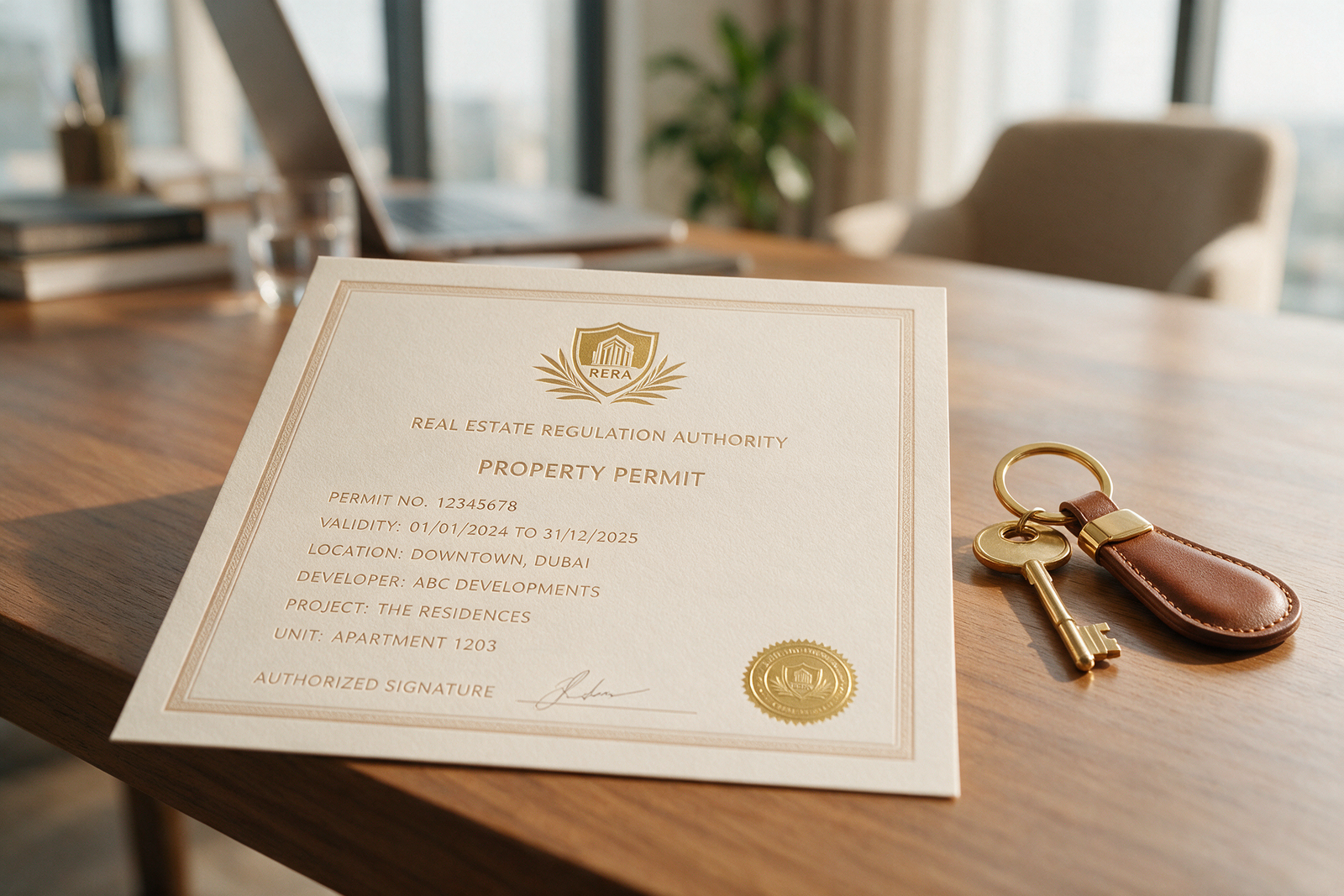
Why the broker card requirement is enforced more consistently than it once was
No individual or company may legally practice real estate brokerage in Dubai without RERA registration, and enforcement now runs through digital verification rather than relying purely on periodic manual checks.
A founder building a brokerage team should confirm every individual agent holds a currently valid, individually registered broker card, since licensing at the company level does not automatically extend to every agent operating under that company.
Letting an agent operate without their own current broker card exposes the brokerage to genuine regulatory risk, not merely a technical oversight.
Consider a growing brokerage that onboarded several new agents quickly during a busy sales period, assuming the company’s own RERA licence covered agents pending their individual broker card registration being finalized.
A routine DLD verification check flagged that two agents had been marketing listings before their individual broker cards were actually issued, prompting the brokerage to build a stricter onboarding checklist requiring confirmed broker card issuance before any new agent could list a single property.
Why mandatory AML training reflects real estate’s specific money laundering exposure
Real estate has long been recognized internationally as a sector vulnerable to money laundering given the scale of individual transactions, and mandatory AML training for all registered brokers reflects Dubai’s specific effort to address this exposure directly at the agent level.
A founder should build AML training into a formal, tracked onboarding process for every new agent, rather than treating it as an informal briefing covered casually during general orientation.
Maintaining clear training completion records also protects the brokerage during any future compliance review, demonstrating this requirement was genuinely satisfied rather than merely assumed.

Why the shift to blockchain verification changes a brokerage’s own record-keeping habits
With the DLD’s transition to blockchain-based contract verification and digital Form F acceptance, a brokerage’s internal record-keeping needs to align with this digital-first verification standard rather than relying on paper trails as the primary evidence of a completed transaction.
A founder should ensure internal systems can properly interface with the DLD’s smart services portal, since a brokerage still operating primarily on paper risks falling behind a market that increasingly expects digital verification as standard practice.
This shift also genuinely speeds up transaction completion for brokerages that adapt to it properly, a meaningful competitive advantage over slower-moving competitors.
Why the new referral fee disclosure rule catches some brokerages by surprise
New rules require brokerages to disclose any payments made to third parties for client introductions, a transparency requirement that some brokerages relying on informal referral networks had not previously needed to formalize.
A founder running a brokerage with an active referral network should build a proper disclosure process now, documenting referral payments clearly rather than treating them as informal arrangements outside the brokerage’s own compliance visibility.
This disclosure requirement exists specifically to protect clients from undisclosed financial relationships that might otherwise influence which property or brokerage gets recommended to them.
Why appearing in RERA’s quarterly performance reports changes competitive dynamics
RERA’s quarterly brokerage performance reports, covering transaction volume, complaint ratios, and compliance scores for the top 100 brokerages, introduce a new form of public accountability many brokerages had not previously faced.
A founder running a brokerage approaching this top 100 threshold should treat complaint ratio and compliance scoring as genuine business metrics worth actively managing, not simply regulatory data collected passively in the background.
A strong public compliance record increasingly functions as a competitive differentiator in a market where this information is now published rather than kept purely internal to the regulator.
Why launching a real estate brokerage still starts with standard UAE company formation choices
A founder establishing a new brokerage still needs to navigate standard mainland versus free zone questions before RERA-specific licensing even becomes relevant, since brokerage activity generally requires mainland licensing to operate across Dubai’s property market properly.
See our guide on the dual-licensing route free zone companies now have into the mainland for how this dual-licensing option interacts with a brokerage’s need for genuine mainland market access.
Why brokerage licensing works differently from a standard trading activity classification
See our guide on what a general trading licence in the UAE actually permits for a useful point of comparison, since real estate brokerage sits under its own distinct activity classification rather than the broader trading categories many founders default to.
Why a brokerage’s own banking relationship faces particular scrutiny given the sector’s risk profile
See our guide on what UAE banks actually require before opening a corporate account for the documentation a real estate brokerage should prepare for, since banks apply heightened scrutiny to this sector given its recognized money laundering exposure.
Why these several new requirements deserve one coherent compliance calendar
See our guide on how to keep broker-specific deadlines inside one compliance system for how broker card renewals, AML training records, and referral fee disclosures should sit inside one coordinated compliance calendar rather than several separately tracked obligations.
Why property marketing materials need their own compliance review alongside licensing
A founder should review all property marketing materials, listing photos, brochures, and online listings, to confirm every one displays a valid RERA permit number as now required, since a properly licensed brokerage can still fall short of compliance through an outdated or incomplete listing.
Auditing existing live listings against this specific requirement, rather than assuming new listings alone need this treatment, catches gaps in older, still-active property listings that might otherwise go unnoticed.
Why a brokerage operating beyond Dubai needs to check each emirate’s own rules separately
A founder running a brokerage with listings across multiple emirates should confirm that Abu Dhabi, Sharjah, and other emirates maintain their own separate real estate regulatory frameworks, distinct from Dubai’s RERA-specific rules covered in this guide.
Assuming Dubai’s specific requirements apply uniformly across every emirate risks a compliance gap in whichever jurisdiction actually maintains different rules.
Why scaling a brokerage team properly still starts with standard UAE employment cost planning
See our guide on the genuine cost of a first UAE hire for the broader employment cost picture a growing brokerage needs to budget for alongside the sector-specific licensing and training requirements already covered.
Why explaining blockchain verification to clients unfamiliar with it builds genuine trust
A founder should prepare a simple, clear explanation of how blockchain-based contract verification actually protects a client’s transaction, since many buyers and sellers encountering this terminology for the first time may feel more uncertain than reassured without proper context.
Framing this technology in terms of the concrete protection it provides, verified, tamper-resistant transaction records, rather than technical jargon, helps clients understand why this shift genuinely benefits them directly.
A brokerage that communicates this well turns a potentially confusing technical change into a genuine trust-building moment with clients navigating an unfamiliar digital process.
A brokerage should also keep a simple internal log tracking when each agent’s broker card and AML training certificate is due for renewal, since a missed individual renewal buried among many agents is exactly the kind of gap a centralized tracking system catches before it becomes a genuine compliance problem.
A founder should also confirm that every marketing partner or portal listing the brokerage’s properties displays licensing information consistently, since a third-party platform showing outdated or missing details reflects on the brokerage even when the platform itself is not directly controlled by it.
Common mistakes when approaching Dubai’s 2026 real estate brokerage rules
- Assuming company-level RERA licensing automatically covers every individual agent’s own broker card requirement.
- Treating AML training as an informal briefing rather than a tracked, documented requirement.
- Leaving referral fee arrangements undisclosed under an informal, pre-2026 network structure.
- Falling behind on blockchain-based verification while competitors adapt their internal systems faster.
A brokerage expanding into a new emirate should confirm that emirate’s own specific real estate regulatory framework before assuming Dubai’s current rules simply carry across unchanged into the new market.
When professional help is worth it
A founder running a small, straightforward brokerage can often manage broker card renewals and AML training directly through RERA’s own published processes. Where guidance is worth the cost is any brokerage scaling its agent team quickly, or one with an active referral network needing a proper disclosure process built from scratch.
Use our interactive tool for comparing UAE free zones when weighing mainland brokerage licensing against a related free zone structure for adjacent real estate advisory activity. Visit the Dubai mainland real estate brokerage licence package for setup support suited to a growing brokerage’s specific compliance needs.
A brokerage already operating for several years benefits from a fresh compliance audit against these 2026 rules specifically, rather than assuming years of accumulated institutional practice already covers every current requirement.
A brokerage entering the market for the first time gains a genuine head start by building its onboarding, training, and disclosure processes around these current rules from day one, rather than launching with an outdated playbook and correcting it later.
A founder unsure where their own brokerage’s current practices genuinely stand relative to these rules benefits from a straightforward external review, since an outside specialist often spots gaps that feel invisible from inside a team’s own day-to-day routine.
Frequently asked questions
Does every Dubai real estate agent need an individual broker card?
Yes, company-level RERA licensing does not automatically cover every individual agent.
Is AML training mandatory for all Dubai brokers?
Yes, it is now a mandatory requirement for all registered brokers.
What is Digital Form F?
An electronically signed version of the buyer and seller MOU, accepted through the DLD's smart services portal.
What does RERA's quarterly performance report cover?
Transaction volume, complaint ratios, and compliance scores for the top 100 brokerages by volume.
Do referral fees need to be disclosed to clients?
Yes, new rules require brokerages to disclose any payments made to third parties for client introductions.
Talk to a setup advisor
Free 20-minute call to confirm the right structure for your business.
Related Reading
 Industry-Specific Licensing
 Dubai Contractor Licensing Law 2026: Mandatory Registration Under Law No. 7 of 2025
 Industry-Specific Licensing
 UAE Advertiser Permit 2026: Who Needs One and Why Unpaid Doesn't Exempt You
 Industry-Specific Licensing
 KHDA's 2026 Compliance Handbooks: 24-Hour Inspection Notice Explained
 Industry-Specific Licensing