
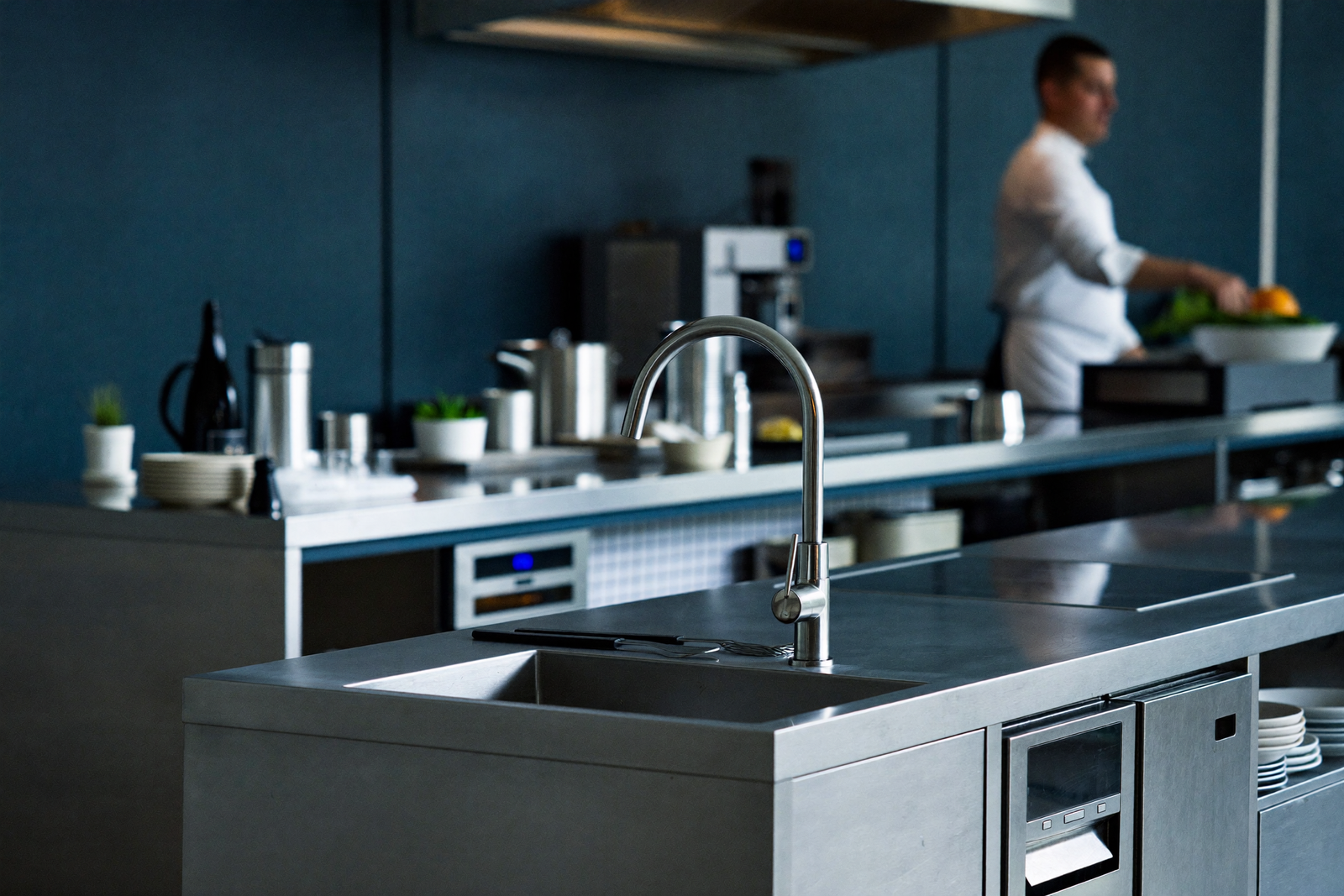
- F&B businesses almost always need a mainland licence — free zones generally cannot support local walk-in food trading, with only narrow exceptions.
- Municipality food-safety approval is a separate process from company registration, covering kitchen layout, ventilation, and hygiene standards.
- Fit-out and municipality compliance costs often exceed the trade licence fee itself, and are frequently underestimated by first-time founders.
- Delivery-only and cloud kitchen models still require the same food-safety approval as dine-in restaurants, though shared commercial kitchens can reduce fit-out cost.
- F&B businesses pay the standard 9% Corporate Tax rate with no qualifying-income exception, since the business model is inherently UAE-local-facing.
- Budget for F&B setup as three separate line items — licence and visas, municipality approval and fit-out, and commercial lease — rather than one combined estimate.
A restaurant, cafe, or food business in the UAE almost always needs a mainland licence: free zones generally cannot support a walk-in food business serving the local public, since the activity depends entirely on the local-trading rights only mainland provides, plus municipality food-safety approval that runs independently of company structure. This is one of the clearest cases where the mainland-versus-free-zone decision isn’t really a choice.
Why free zone rarely works for F&B
For the wider opportunity behind this specific licensing decision, see e.zone’s piece on unlocking the potential of the UAE’s food and beverage industry.
A free zone company’s core limitation (no direct trading with UAE consumers without a distributor) is fundamentally incompatible with a restaurant’s business model, since a restaurant’s entire revenue depends on serving walk-in local customers directly. The handful of exceptions (a free zone with an on-site food court specifically built for public dining, or a purely export-focused food production business with no local dine-in component) are narrow enough that most founders opening a restaurant, cafe, or food delivery business should plan around mainland from the outset rather than exploring free zone options first.
| Factor | Mainland (typical for F&B) |
|---|---|
| Trade licence (year 1) | AED 16,000 – 22,000+ |
| Municipality food safety approval | Separate process, required regardless of licence type |
| Physical premises | Required, subject to health/safety fit-out standards |
| Local UAE customer trading | Direct, no distributor needed |
“The mainland-versus-free-zone question barely applies to F&B. The real cost driver is the municipality approval and fit-out, not the licence type.”
F&B setup: what actually drives cost beyond the licence
What’s predictable
- Licence fee itself follows standard mainland pricing
- Trading rights are automatic with a mainland licence: no distributor step
What’s harder to budget for
- Municipality food-safety fit-out costs vary widely by premises condition
- Kitchen equipment and ventilation compliance can exceed the licence cost itself
- Approval timelines depend on municipality inspection scheduling, not just paperwork
The municipality approval process, separate from company formation
Beyond the DED trade licence, a food business needs approval from the relevant emirate’s municipality or food safety authority, covering kitchen layout, ventilation, food handler certifications, and hygiene standards: this process runs in parallel with, not as part of, company registration, and can take longer than the licence itself if the premises needs fit-out work to meet standards. Founders often underestimate this step specifically because it isn’t part of the “company setup” conversation at all: it’s a separate regulatory track that happens to be mandatory before the restaurant can actually open, regardless of how quickly the trade licence itself was issued.
A founder opening a small café budgeted primarily around the mainland trade licence fee, assuming the total setup cost would land near AED 20,000. The municipality’s food safety inspection flagged the leased space’s ventilation system as inadequate for commercial cooking, requiring a retrofit that cost more than the licence itself. The lesson she now shares with other first-time F&B founders: get the space pre-assessed against municipality kitchen standards before signing a lease, not after, since a lease locked in on an unsuitable space adds cost and delay that has nothing to do with the company formation process at all.
Does a delivery-only or cloud kitchen model change anything?
A delivery-only or cloud kitchen model still requires the same municipality food-safety approval as a dine-in restaurant, since the health and hygiene requirements apply to food preparation regardless of whether customers eat on-site: the absence of a dining room reduces fit-out cost in some respects (no need for customer-facing furniture, decor, or a full front-of-house layout) but doesn’t remove the licensing or inspection requirement itself. Cloud kitchen operators sometimes share a licensed commercial kitchen facility specifically built for this model, which can meaningfully reduce both cost and approval timeline compared to fitting out a standalone space from scratch.
Corporate Tax treatment for a mainland F&B business
An F&B business, being inherently UAE-local-facing, is squarely mainland territory and pays the standard 9% Corporate Tax rate above the profit threshold with no qualifying-income exception available: the free zone 0% regime discussed in our guide on free zone tax treatment for F&B businesses simply isn’t relevant to a business built around local walk-in trade. This is worth factoring into financial projections from day one rather than assuming a lower effective tax rate that a mainland F&B business generally can’t access.
Staffing and visa considerations specific to F&B
F&B businesses typically need more visas per unit of revenue than a consulting or e-commerce business, since kitchen and front-of-house roles don’t scale the way service-based work does. This makes visa package planning worth doing carefully from the outset: see our visa cost breakdown within our mainland versus free zone comparison for how per-visa costs add up at higher headcounts.
A small cafe might need only 2-3 staff visas, but a full-service restaurant with a kitchen brigade and dedicated front-of-house team can easily need 8-10, which meaningfully changes the office and visa package tier required under a mainland licence.
Building a realistic total budget
A realistic F&B setup budget needs three separate line items tracked independently: the mainland trade licence and visas (following the same structure as our full first-year company setup cost breakdown), the municipality food-safety approval and any required fit-out, and the commercial lease itself, which for F&B premises often carries higher rent than a general office given foot-traffic location requirements. Treating these as one combined “setup cost” rather than three distinct budgets is the most common planning mistake among first-time F&B founders. For a realistic quote across all three components together, e.zone’s F&B licensing advisors can coordinate licensing and municipality approval as one process rather than sequential, disconnected steps.
Frequently asked questions
Can I open a restaurant through a UAE free zone company?
Generally no — free zone companies cannot trade directly with UAE consumers, which is fundamentally incompatible with a restaurant's local walk-in business model. Mainland is the standard route.
What approvals does a restaurant need beyond the trade licence?
Municipality or food safety authority approval covering kitchen layout, ventilation, hygiene standards, and food handler certifications — a separate process from company registration.
Does a cloud kitchen or delivery-only business need the same approvals as a dine-in restaurant?
Yes — the same food-safety and hygiene approval applies regardless of whether there's a dining room, though fit-out costs are often lower without customer-facing space.
How much does it cost to open a small restaurant in the UAE?
The mainland licence itself typically runs AED 16,000–22,000, but total setup cost including municipality fit-out and lease commonly exceeds this significantly depending on the space's starting condition.
Do F&B businesses get any Corporate Tax benefit?
No — since F&B is inherently a local-trading, mainland business model, it pays the standard 9% rate with no access to the free zone qualifying-income 0% regime.
Should I sign a lease before or after municipality approval is confirmed?
Ideally, have the space pre-assessed against municipality kitchen and hygiene standards before signing — committing to an unsuitable space adds cost and delay unrelated to company formation itself.
Talk to a setup advisor
Free 20-minute call to confirm the right structure for your business.
Related Reading
 Industry-Specific Licensing
 ICV Certificate: How It Actually Affects UAE Government Contract Eligibility
 Industry-Specific Licensing
 UAE Freight Forwarding and Logistics Licence: Cost, CRN, and Requirements
 Industry-Specific Licensing
 UAE Travel Agency Licence: DTCM Approval, Cost and Requirements
 Industry-Specific Licensing