
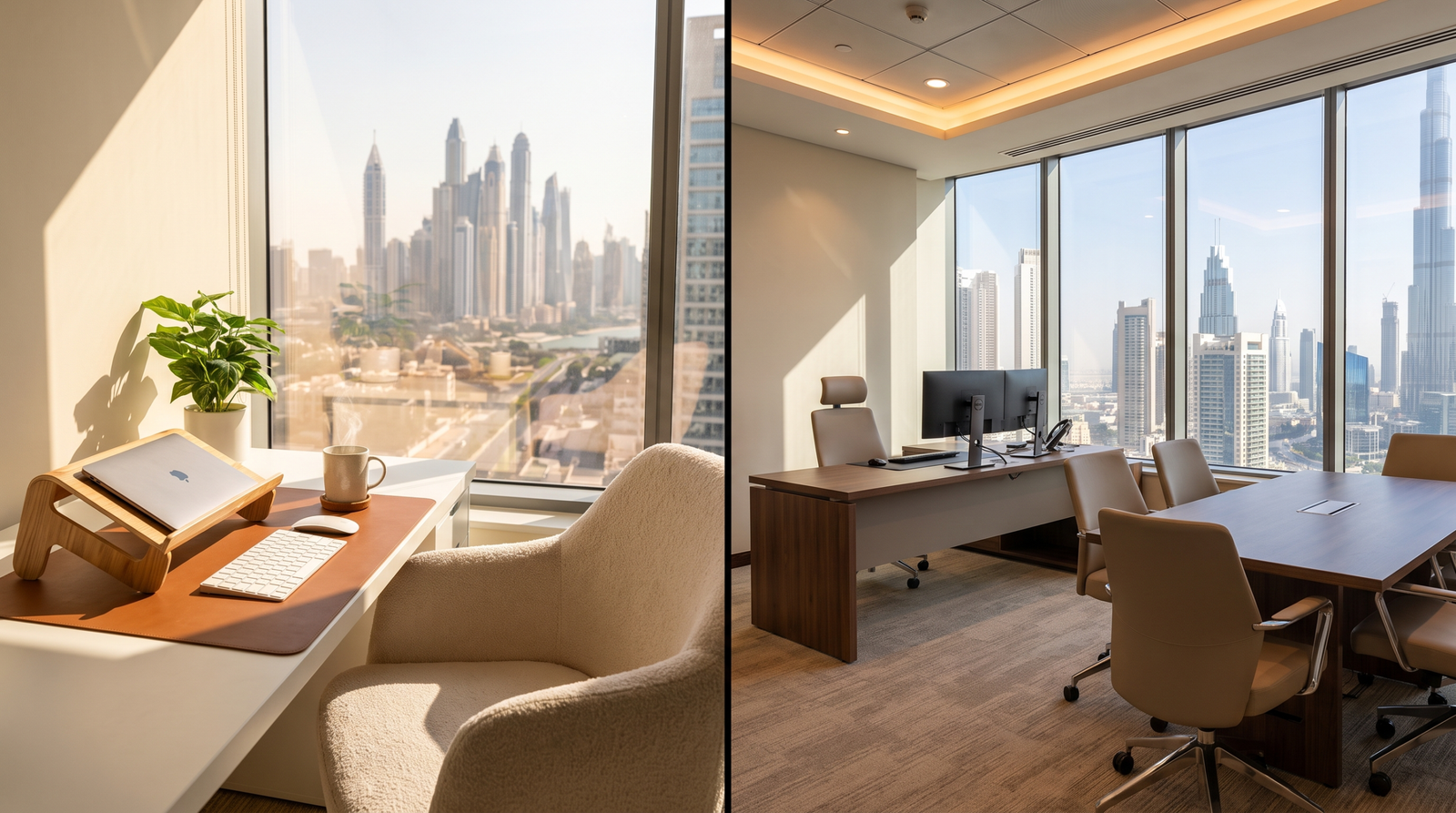
- A free zone virtual office runs AED 3,500-12,000 a year versus AED 15,000-60,000 for a physical office.
- A Dubai mainland DET trade licence never accepts a virtual office; a genuine Ejari-registered lease is mandatory.
- Virtual offices typically cap visa sponsorship at one or two visas regardless of staffing needs.
- The cost gap between virtual and physical offices compounds every renewal year, not just at setup.
- A lack of physical presence can factor into how banks evaluate a corporate account application.
- Free zones generally allow upgrading or downgrading office tiers at renewal time.
A UAE free zone virtual office or flexi-desk runs AED 3,500 to 12,000 a year and satisfies the legal office requirement for most free zone trade licences, while a genuine physical office in a free zone costs AED 15,000 to 60,000 annually depending on size and location. Mainland licensing removes this choice entirely: a virtual office is not accepted for a Dubai DET trade licence, and every mainland company must maintain a physical, Ejari-registered tenancy regardless of how small the operation actually is.
This guide covers when a virtual office is genuinely acceptable, why mainland companies have no flexibility on this point at all, and the real cost gap between the two options once every line item is counted.
What a virtual office or flexi-desk actually provides
A virtual office or flexi-desk arrangement, offered by most UAE free zones, provides a company with a registered business address and the paperwork needed to satisfy the free zone’s office requirement for licensing purposes, without the company actually occupying dedicated physical space full-time. Some packages include limited access to shared co-working space or meeting rooms on an as-needed basis, while others are purely a registered address with no physical access component at all. This is sufficient for a founder running a genuinely remote or home-based operation who needs a legally compliant business address without the overhead of leasing and furnishing dedicated office space.
The tradeoff is that a virtual office typically caps the number of visas a company can sponsor, since free zones tie visa quotas to a minimum physical space allocation, meaning a founder planning to sponsor several employees will likely need to upgrade to a larger office format regardless of whether the business genuinely needs the physical space for day-to-day operations.
| Setup type | Typical annual cost (AED) |
|---|---|
| Free zone virtual office / flexi-desk | 3,500 – 12,000 |
| Free zone dedicated physical office | 15,000 – 60,000 |
| Mainland physical office (Ejari-registered, mandatory) | From ~12,000 upward, no virtual option |
| Lowest realistic year-one setup (free zone virtual) | Under 25,000 all-in |
“A free zone will happily license a company that exists on paper and a shared address. A mainland licence won’t. That single difference is often the real deciding factor between the two jurisdictions, more than tax treatment or trading rights ever are for a small, remote-first business.”
Why mainland licensing categorically rejects virtual offices
A Dubai mainland DET trade licence requires a genuine, Ejari-registered tenancy contract for every company, with no virtual or shared-address alternative accepted regardless of company size, activity type, or the founder’s actual operational needs. This is a firm regulatory line rather than a cost-driven business decision on DET’s part, meaning a founder cannot negotiate a virtual arrangement for a mainland licence the way flexibility sometimes exists around other setup requirements. Any founder budgeting a mainland setup under the assumption that a virtual office might eventually be an option, once the licence is approved or the business proves itself, is working from an incorrect premise; the physical office requirement applies from day one and throughout the company’s life on the mainland.
This requirement exists partly because mainland companies can serve walk-in clients and operate more broadly across the emirate, and partly because mainland regulatory oversight is structured around verifiable physical presence in a way free zone licensing, historically built around attracting remote and internationally focused businesses, was not.
Consider a founder who initially planned a mainland consulting business, having read that mainland licensing offers unrestricted access to serve clients anywhere in the UAE, without realizing this meant committing to a genuine Ejari-registered office lease from day one. After receiving cost quotes that included a mandatory office lease alongside the trade licence fees, well above the founder’s original budget for a remote-first consulting operation, the founder reconsidered and instead registered the business in a free zone with a flexi-desk arrangement, accepting the free zone’s restrictions on direct mainland client contracts in exchange for the considerably lower and genuinely virtual office cost.
When a virtual office genuinely fits the business, and when it doesn’t
A virtual office arrangement fits well for a solo founder or very small team running a genuinely remote consulting, digital services, trading, or holding business with no walk-in client requirement and no near-term plan to sponsor more than one or two visas. It fits considerably less well for any business that needs to meet clients in person regularly, store inventory, or operate with a visible physical storefront or showroom, since a virtual office by definition does not provide dedicated, always-available physical space for these functions.
Founders should also consider how a virtual office reads to banks and clients evaluating the business’s credibility. While virtual offices are entirely legal and commonly used, some banks apply additional scrutiny to corporate account applications from companies with no dedicated physical presence, treating it as one factor among several when assessing overall business substance during account opening review.

Why visa sponsorship is the practical limit that pushes founders toward physical space
Free zones generally tie a company’s visa sponsorship quota to its office format, with virtual office and flexi-desk arrangements typically capped at one or two visas regardless of the business’s actual staffing needs. A founder planning to grow a team of five or more within the first year or two should factor this limitation into their initial office choice, since upgrading from a virtual office to a larger physical space specifically to unlock additional visa quota is a common, foreseeable expense that a growth-oriented business should budget for from the outset rather than treating as an unexpected mid-year cost.
This coupling between office size and visa quota is one of the more consequential hidden costs in UAE company setup, since a headline “cheapest free zone” comparison based purely on virtual office pricing does not reflect the true cost a growing business will actually incur once it needs to sponsor staff beyond the virtual tier’s limit. See our guide on hidden UAE company setup costs most quotes don’t include for other cost gaps that show up between a headline setup quote and the real first-year total.
How this compares to the flexi-desk versus dedicated office decision within a single free zone
The virtual-versus-physical decision covered here sits alongside a related but distinct question many founders face once they’ve already chosen a free zone: whether to take a basic flexi-desk arrangement or a fuller dedicated office within that same jurisdiction. See our guide on flexi-desk versus dedicated office in a UAE free zone for how that more granular comparison plays out once mainland has already been ruled out and the remaining question is simply how much physical space a specific free zone company actually needs.
Why the gap compounds meaningfully over a company’s first few years
The cost difference between a virtual office and a physical office is not a one-time setup gap; it recurs every single year as part of the licence renewal cycle, meaning a founder who chooses a virtual office over a physical one is not simply saving money in year one but compounding that saving across every subsequent renewal for as long as the business stays within the virtual office’s visa and operational limits. Over a three-year horizon, this can represent tens of thousands of dirhams in avoided office cost for a business that genuinely does not need dedicated physical space, making the virtual office choice considerably more financially significant over time than a single year’s cost comparison suggests.
Founders should weigh this compounding saving against the genuine limitations a virtual office imposes, since choosing the cheaper option purely on cost grounds without accounting for visa quota and client-facing needs can force a disruptive mid-cycle upgrade that costs more in total than choosing the right-sized office from the outset would have.
How office choice can quietly affect a company’s early banking experience
Beyond the direct cost and visa quota implications, a company’s office arrangement can factor into how UAE banks evaluate its corporate account application during onboarding, since banks generally treat a genuine physical presence, however modest, as one signal of operational substance alongside the other documentation a business provides. A virtual office is entirely legitimate and does not automatically disqualify an account application, but a founder should be prepared for a bank relationship manager to ask more detailed questions about the business’s actual operations when the registered address is a shared or virtual arrangement rather than dedicated space the company physically occupies.
This is generally a manageable part of the account opening conversation rather than a genuine obstacle, provided the founder can clearly explain the business model and demonstrate that the virtual office arrangement is a deliberate, appropriate choice for a genuinely remote-first operation rather than an attempt to obscure where the business actually operates from.
Why some businesses benefit from mixing both approaches over time
A founder does not necessarily need to commit permanently to one office format for the life of the business; some companies deliberately start with a virtual office during their leanest early months, then upgrade to dedicated physical space once revenue and headcount justify the added cost, while others take the reverse path, starting with a larger office to support an anticipated hiring wave and scaling back to a smaller format if growth takes longer than expected. Free zones generally allow this kind of upgrade or downgrade at renewal time, meaning the office decision does not need to be treated as permanently fixed at incorporation, provided the founder plans the transition around the annual renewal cycle rather than trying to change formats mid-term. A founder anticipating this kind of transition should ask the free zone directly, before signing the first-year agreement, exactly how an upgrade or downgrade is processed and whether any portion of the current term’s fees carries over, since these transition mechanics vary meaningfully between free zones and are easy to overlook until the moment an upgrade is actually needed.
Common mistakes when choosing between a virtual and physical office
- Assuming a mainland licence might eventually accept a virtual office arrangement once the business is established.
- Choosing the cheapest virtual office option without checking its visa sponsorship quota against actual hiring plans.
- Treating a headline “cheapest free zone” comparison as complete without factoring in the office-to-visa-quota coupling.
- Underestimating how a lack of physical presence can factor into bank corporate account review.
When professional help is worth it
A solo founder with a clear, remote-first business model and no near-term hiring plans can often choose a virtual office arrangement directly based on cost alone. Where guidance is worth the cost is any business planning to scale headcount within the first year or two, since the interaction between office tier, visa quota, and renewal cost is easy to underbudget without seeing the full multi-year picture. e.zone’s setup planning advisors can map your growth plan against the right office tier before you commit to a package that limits your hiring later.
Frequently asked questions
Can a UAE mainland company use a virtual office?
No. A Dubai mainland DET trade licence requires a genuine Ejari-registered tenancy contract, with no virtual or shared-address alternative accepted.
How much does a UAE free zone virtual office cost?
A free zone virtual office or flexi-desk typically costs AED 3,500 to 12,000 a year, compared to AED 15,000 to 60,000 for a dedicated physical office.
How many visas can a virtual office sponsor?
Virtual office and flexi-desk arrangements are typically capped at one or two visas, since visa quota is generally tied to the physical office space leased.
Does a virtual office affect UAE bank account applications?
It can. Some banks apply additional scrutiny to companies with no dedicated physical presence, treating it as one factor among several when assessing business substance.
Can I upgrade from a virtual office to a physical office later?
Yes. Free zones generally allow upgrading or downgrading office formats at renewal time, so the choice does not need to be permanent.
Talk to a setup advisor
Free 20-minute call to confirm the right structure for your business.
Related Reading
 Business Costs & Fees
 UAE DEWS End-of-Service Savings Scheme: What Employers Actually Need to Know
 Business Costs & Fees
 The Real Cost of Hiring Your First Employee in a UAE Company
 Business Costs & Fees
 UAE Company Liquidation Cost: What Closing a Business Actually Costs
 Business Costs & Fees